Robin Berjon

Robin Berjon has worked on technology and its governance for thirty years, including as Vice President of Data Governance at The New York Times, as editor of the HTML5 specification at the W3C, and on decentralised systems at Protocol Labs. His work focuses on making the digital sphere compatible with democracy: open protocols, institutional design, and the governance of infrastructure.
News
-
Construir el futuro
This second edition of Construir el futuro, an event organised by the Meridiano Institute which seeks to put climate change back at the center of contemporary politics. Along with the excellent Xan López we’ll be discussing a forthcoming report on the management of public identities.
-
Trefdag Vlaanderen Digitaal 2026
Talking about sovereignty, social media, and identity.
-
Institute of Open Science Practices — IOSP 2026
An event for the people building, using, and advancing the infrastructure open science depends on. I’ll be demonstrating work relating to publishing datasets to the Atmosphere.
-
#Disinfo2026: double-session, Unshitted and Trust & Safety through decentralised platforms
The counter-disinformation community meets for #Disinfo2026 in Vilnius, Lithuania.
-
A Real Digital Omnibus for European Competitiveness and Security
Our report on the data provisions of the Digital Omnibus: a framework for trilogue negotiators to tell the provisions that genuinely simplify from those that would undermine the trusted environment European competitiveness depends on.
-
Testimony to the Council of Europe Committee of Experts on Media Regulators in a Platform-Based Environment
An expert consultation from the Council of Europe on media regulation and social media.
-

Media Media
The authoritarians are winning, we can all see that. It wouldn’t be the worst thing if the pro-democracy camp stopped being naive about social media.
-
Rebuild 2 in Helsinki
The second Rebuild gathering, in Helsinki: a summer camp where the people building Europe’s social platforms teach each other how to build, design, and scale them.
-
Souveraineté numérique : qu’est-ce qu’Eurosky, ce projet de web social européen ?
Interviewed (in French) by Mathilde Saliou for Next about Eurosky, the European social web project, and what sovereignty means beyond the Silicon Valley model.
-
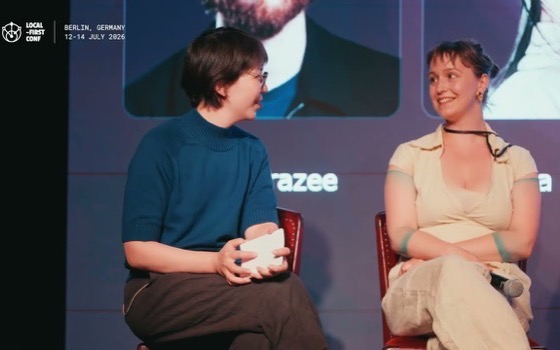
Data Ownership Beyond Local First, at Local-First Conf
I joined a panel at Local-First Conf 2026 in Berlin with Paul Frazee, Boris Mann, and Zenna Fiscella on what data ownership means beyond local-first software.
-

The Retweeting Class
I have often found myself confounded by the behaviour of some people who seem impervious to reality — like the people still on X today. Here, I try to understand what grounds their epistemology and its consequences, and what that means for the rest of us. Being committed to a better future is where genuine seriousness is, and that seriousness can only be approached in a spirit of embodied, determined, relentless hope.
-
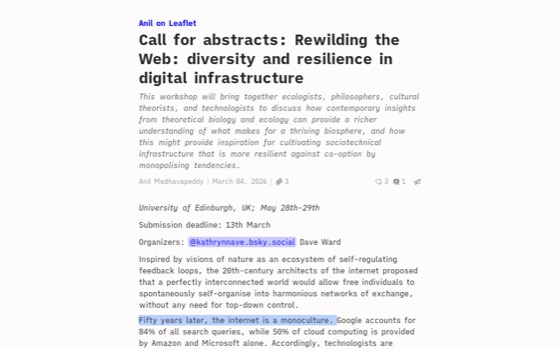
Rewilding the Web: diversity and resilience in digital infrastructure
A two-day workshop at the University of Edinburgh bringing ecologists, philosophers, cultural theorists, and technologists together around the idea of rewilding the internet.
-

« La souveraineté numérique se construit par étapes, et si les institutions ne bougent pas, le public ne bougera pas »
In Le Monde, Nicolas Hénin and I argue that the French state’s satirical X account, French Response, is a tactical answer to a strategic problem, and that institutions should invest in healthy, well-governed platforms so that the public follows.
-

Funding The Web: From Cartel to Covenant
Our report on the search/browser levy — the little-known system that funds browsers, enforces a search monopoly, and defunds the rest of the web — and how to reform it.
-

The Direction of Interoperability
Talking in terms of horizontal or vertical interoperability is too constrictive a mental model to understand what interoperability does. Doing better matters, and it’s right within reach.
-
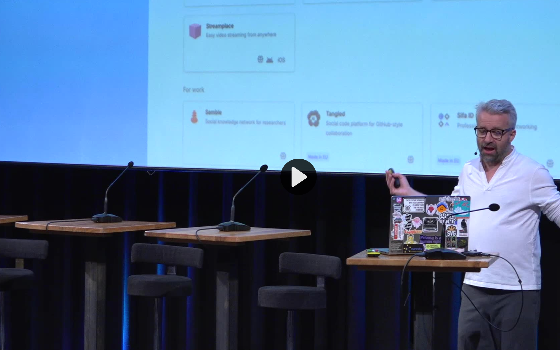
We Build On Hope: keynote at PublicSpaces 2026
My keynote at PublicSpaces 2026 in Amsterdam: the current state of tech can feel disheartening, but we have every reason to hope — and a strategy to bring democracy to the internet.
-

On RTÉ Radio 1: should Europe wean itself off US tech?
I joined Today with David McCullagh on RTÉ Radio 1, alongside Dr Hazel Murray of Munster Technological University, to discuss Europe’s dependence on US technology and how to reduce it.
-
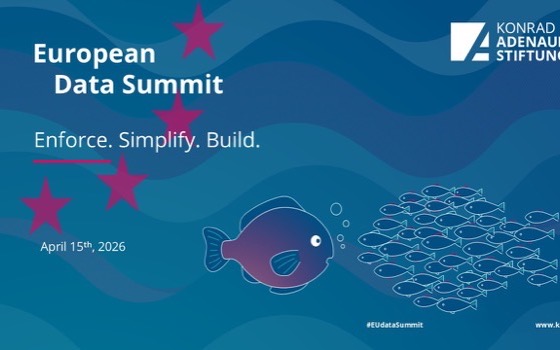
Social media as digital public infrastructure, at the European Data Summit
I gave a keynote on building a thriving open social web for Europe at the Konrad-Adenauer-Stiftung’s European Data Summit 2026 in Berlin, followed by a panel on social media as digital public infrastructure.
-
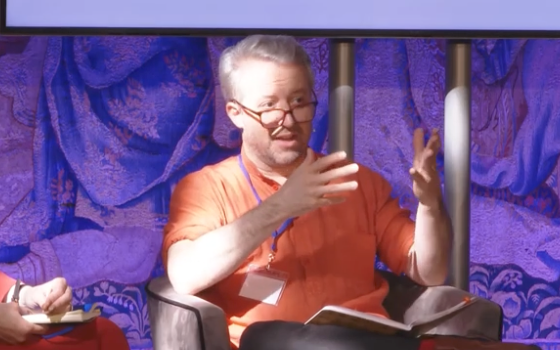
Cambridge Disinformation Summit
I spoke at the Summit about the infrastructure needed to support sovereignty.
-
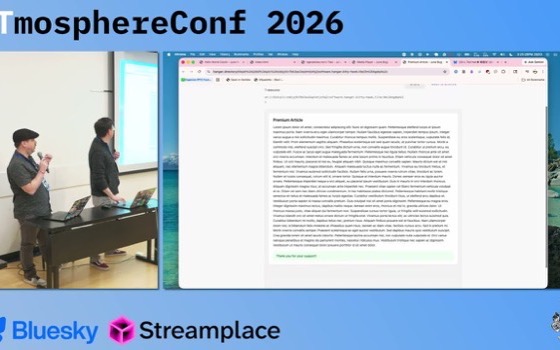
WebTiles and Matadata at ATmosphereConf 2026
Two presentations at ATmosphereConf 2026 in Vancouver: the WebTiles Showcase with Ted Han, and a lightning talk on Matadata, publishing scientific data straight to AT.
-

Testifying before the Assemblée nationale on France’s digital dependencies
I testified before the Assemblée nationale’s commission of inquiry into France’s structural dependencies and systemic vulnerabilities in the digital sector; its report, published in July 2026, draws on the hearing.
-

Rebuild 1: a sprint for European social platforms
I took part in Rebuild 1 in Copenhagen, the first of three 48-hour gatherings of the people building Europe’s next generation of social platforms.
-
Keynote at the EU Tech Stars Summit
I gave the opening keynote of the Greens/EFA EU Tech Stars Summit in the European Parliament, a day with the European tech ecosystem that champions democracy, privacy, and transparency.
-

Résilience numérique européenne et géopolitique en 2026
An evening for decision-makers, journalists, patrons, scientists, open-source advocates, and citizens who wish to learn, reflect, and take concrete action toward developing a European digital space that is sovereign and resilient to geopolitical disruptions, at the Institut des Systèmes Complexes de Paris Île-de-France (CNRS).
-

Fascintern Media
We are facing a coordinated international fascist movement that works with explicit backing from Moscow, Washington, and tech monopolies, and is propagating itself through its own media apparatus. Yet people who claim to side with democracy keep doing work to support Fascintern media because they misunderstand how it works. This needs to change.
-
Eurosky Live: Putting the Demo in Democracy
The launch conference for the Eurosky project.
-

The Democratic Tech Alliance is founded
The Democratic Tech Alliance brings MEPs from across political groups together with civil society, experts, and European businesses to build an EU tech ecosystem that serves democracy. I sit on its steering committee.
-

How Many More Cloud Scares Does Europe Need?
In Project Syndicate: the AWS and Azure outages show the threat US cloud dominance poses to Europe, and why the EU must dismantle the entrenched monopolies undermining its tech sovereignty.
-

How Wikipedia Can Save the Internet With Advertising
How principled advertising on Wikipedia could fund a democratic digital future.
-

Airbus for AI: A Global Strategy for Public Value Creation
With Joshua Tan, Brandon Jackson, and Diane Coyle, a policy brief for a Public AI Company: an Airbus-style partnership among middle powers to build frontier AI in the public interest.
-
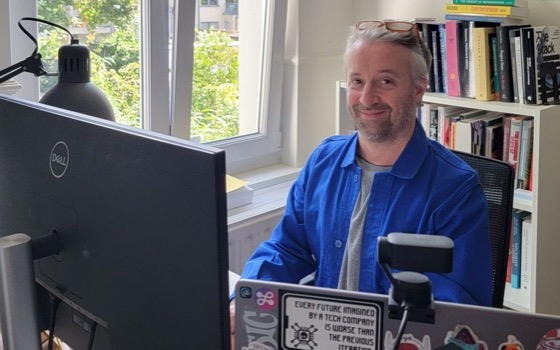
Should Europe wean itself off US tech?
Quoted in the BBC on Europe’s dependence on three US firms for 70% of its cloud computing, and why the risk of a US “kill switch” should be taken seriously.
-
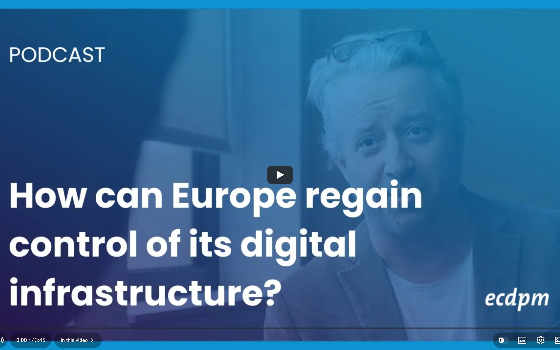
What is digital sovereignty and how can Europe achieve it?
Europe has experienced a sense of losing control over its digital ecosystem and economic considerations, coupled with a perception that its innovation in the technology world is lagging. In this foundational episode, Chloe Teevan and Gautam Kamath explore the critical concept of digital sovereignty with Robin Berjon and why it demands attention from policymakers worldwide.
-

Digital sovereignty can’t be bargained away
In POLITICO Europe, Cori Crider and I argue that the Commission has the tools, public support, and mandate to act on Big Tech, and that trading them away in US trade talks would be a costly mistake.
-
Open Protocols and Public Interest Social Media at IGF 2025
I spoke at a workshop on open protocols and public interest social media at the Internet Governance Forum in Lillestrøm, convened with the Digital Public Goods Alliance and Project Liberty Institute.
-
Towards European technological sovereignty and a resilient digital public sphere
At the Digital Summit closing the Polish Presidency of the EU in Gdańsk, I joined a session on European technological sovereignty and a resilient digital public sphere co-hosted by Panoptykon, Mozilla, the Future of Technology Institute, Open Future, and the Open Markets Institute.
-
AI Renaissance 2025
I took part in AI Renaissance, Metagov’s residential unconference on the political economy of AI at Bückeburg Palace: new infrastructure, business models, and institutions for public, open-source, and decentralised AI.
-
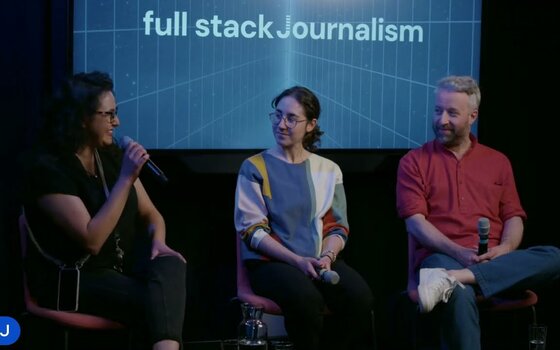
Interfaces and influence, on Full Stack Journalism
I joined Sara Cooper and Tina Lee on the second episode of Full Stack Journalism, hosted by Sabrina Faramarzi, on the hidden influences built into the technology newsrooms use every day.
-

Web Engines Hackfest
I will be at Web Engines Hackfest, meeting with people who want to figure out where browsers should be going next.
-

Re:publica: How We Can Finally Make The Digital World Democratic
I will be speaking at Re:publica on May 28, 2025, at 1300, about how we can build independent social media infrastructure as a first step in the movement to make our digital world democratic.
-

re:publica 25
Our digital sphere is authoritarian and as the internet is infrastructure for society this makes our world authoritarian too. In this talk, I explain how to use open protocols, pro-democracy technical architectures, and our understanding of digital infrastructure to build democratic social media.
-
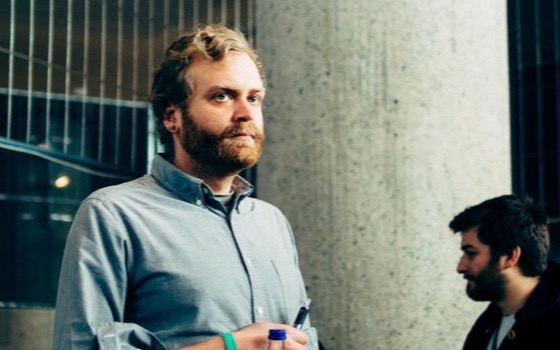
What’s next for social media?
Quoted in the BBC, as one of Free Our Feeds’ custodians, on why Bluesky’s infrastructure must not stay in the hands of a single operator.
-

Originator Profile
I met with the Originator Profile in Tokyo, a project bringing together a large group of media companies to develop ways of marking content as authentic.
-

'Rewilding' To Feature in 'Best American Science & Nature Writing 2025'
Our ‘We Need To Rewild The Internet’ essay, with Maria Farrell, has been selected to be included in the ‘Best American Science & Nature Writing 2025’ anthology.
-

Digital & Data Sovereignty: Definitions and Technologies for Independence and Resilience
I joined a Global Governance Talk panel at the Graduate Institute in Geneva, convened by Emrys Schoemaker, to discuss data sovereignty and infrastructure with the wider UN community.
-

The Next Social Wave: Open, Competitive, and User-Controlled
I joined this Future of Tech Institute panel hosted by Sherif Elsayed-Ali alongside Marietje Schaake and Emily Liu, to discuss the new wave of decentralised social media.
-

Algorithmic Pluralism: Towards Competitive & Innovative Information Ecosystems
Sherif Elsayed-Ali and I co-authored this Future of Technology Institute report on ‘algorithmic pluralism’, the idea according to which democracy requires pluralism in all editorial channels, including algorithms that determine what is relevant to people.
-

PETs and AI: Privacy Washing and the Need for a PETs Evaluation Framework
I took part in this Dagstuhl seminar on PETs and privacy washing. The participants were excellent, I look forward to the paper that will come from this.
-

Digital Sovereignty
Digital sovereignty has a bad reputation. In internet governance circles, sovereignty is considered awkward enough to be referred to by as the “s-word.” It is often associated with misguided attempts at returning to the era of national champions, like building a French search engine or a European Google, or worse with the eternal boogeyman that is the “splinternet.” It doesn’t have to be this way!
-
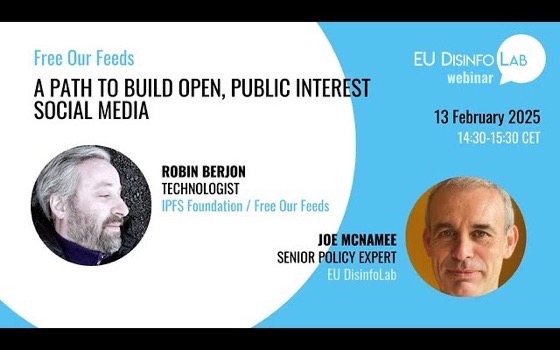
Free Our Feeds, explained for EU DisinfoLab
An EU DisinfoLab webinar with Joe McNamee on how open protocols can free us from polarising algorithms and build public interest social media.
-

Brux Conference Perfect Storm 2025: Europe - Community or Colony? Can we Build our Own Digital Infrastructure?
A panel on sovereignty and infrastructure with Cristina Caffarra, Axel Voss, Marian Gläser, Jonas Andrulis, Andy Yen, and Ivan De Lastours.
-
Free Our Feeds launches — and I am one of its custodians
Free Our Feeds is a campaign to build open, people-powered social media on the AT Protocol, governed in the public interest. I serve as one of its custodians.
-
Social Media as It Should Be
In Project Syndicate: how the Bluesky model — public protocols rather than private platforms — could restore the original promise of the internet.
-
#EuroStack: European Strategic Sovereign Digital Infrastructures
The EuroStack pitch document: why Europe must join and build its own digital infrastructures, from chips to data to compute to connectivity, and how to start.
-
Building the EuroStack, in the European Parliament
I spoke at “Toward European Digital Independence: Building the EuroStack”, the cross-party conference in the European Parliament that launched the EuroStack initiative.
-

The Struggle Over Digital Infrastructure
We need to radically strengthen the transnational nature of multistakeholder digital infrastructure governance.
-

“Google is a Monopolist” – Wrong and Right Ways to Think About Remedies
What potential remedies now stand a chance of establishing competition in search? Cristina Caffarra and Robin Berjon consider the question.
Videos
-
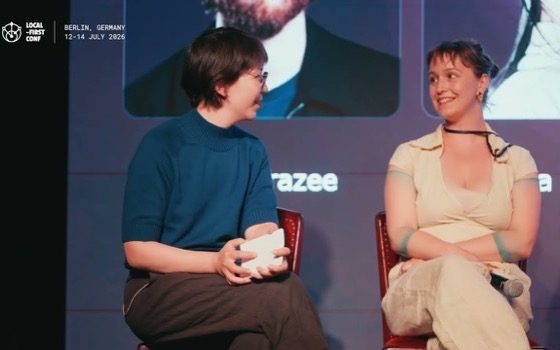
Data Ownership Beyond Local First video
A panel at Local-First Conf 2026 in Berlin with Paul Frazee (Bluesky), Boris Mann (Ink & Switch), and Zenna Fiscella (Scuttlebutt), moderated by Eileen Wagner: what data ownership means once you look past local-first software.
-
We Build On Hope video
The current state of tech can feel disheartening. But we have every reason to hope.
-

Should Europe wean itself off US tech? — RTÉ Radio 1 video
A twelve-minute conversation on Today with David McCullagh, with Dr Hazel Murray of Munster Technological University, about Europe’s dependence on US technology and what it would take to reduce it.
-
Building a thriving open social web for Europe — European Data Summit 2026 video
My keynote at the Konrad-Adenauer-Stiftung’s European Data Summit 2026, followed by the panel “Digital Public Infrastructure — the Social Media Issue”.
-
Cambridge Disinformation Summit video
Robin Berjon, Principal, Supramundane Agency, discusses digital sovereignty and infrastructure needed to support sovereignty.
-
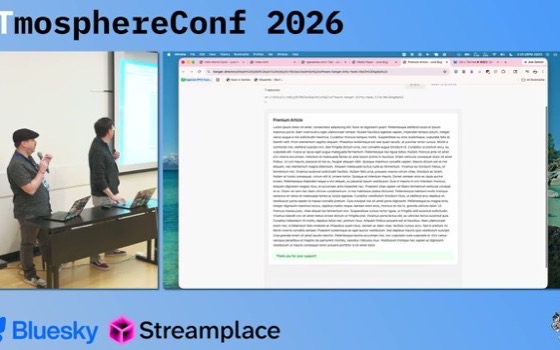
ATmosphereConf 2026: WebTiles Showcase and Matadata! 2 videos
My two sessions at ATmosphereConf 2026 in Vancouver: a showcase of WebTiles with Ted Han, and a lightning talk on Matadata, publishing scientific data straight to AT.
-

Vulnérabilités systémiques dans le secteur du numérique : audition à l’Assemblée nationale video
My testimony before the Assemblée nationale’s commission of inquiry into France’s structural dependencies and systemic vulnerabilities in the digital sector, in a round table with David Chavalarias and Maud Quessard.
-
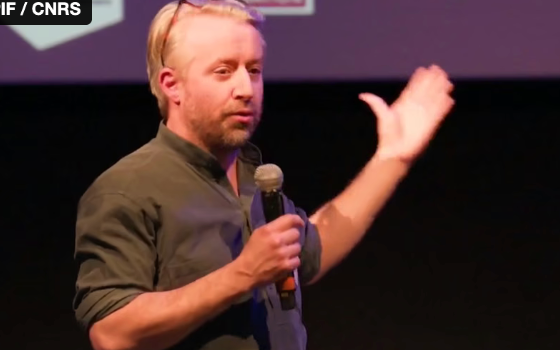
De l’usage démocratique des protocoles video
Soirée destinée aux décideurs, journalistes, mécènes, scientifiques, libristes, citoyennes et citoyens qui souhaitent s’informer, réfléchir et agir concrètement pour le développement d’un espace numérique européen souverain et résilient aux perturbations géopolitiques.
-
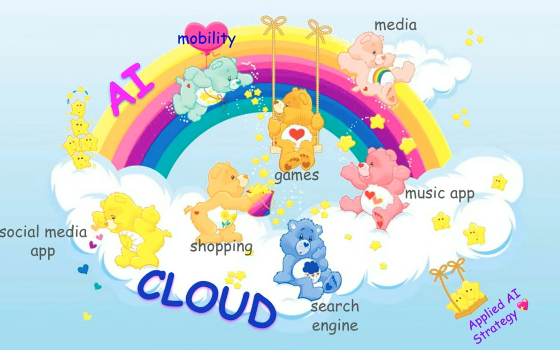
Digital Building Blocks: ATProto and Eurosky Explained video
Explaining ATProto and Eurosky at the Eurosky Live 2025 conference.
-
What is digital sovereignty and how can Europe achieve it? video
Europe has experienced a sense of losing control over its digital ecosystem and economic considerations, coupled with a perception that its innovation in the technology world is lagging. In this foundational episode, Chloe Teevan and Gautam Kamath explore the critical concept of digital sovereignty with Robin Berjon and why it demands attention from policymakers worldwide.
-
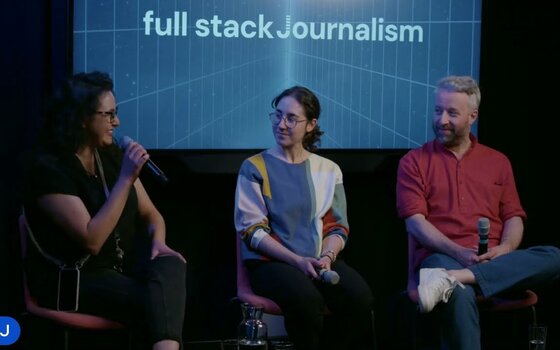
Interfaces and influence: Reclaiming Newsroom Technology — Full Stack Journalism video
Episode two of the Full Stack Journalism live podcast, with Sara Cooper, Tina Lee, and host Sabrina Faramarzi, on the hidden influences underpinning the technology newsrooms depend on.
-

re:publica 25: How We Can Finally Make The Digital World Democratic video
Our digital sphere is authoritarian and as the internet is infrastructure for society this makes our world authoritarian too. In this talk, I explain how to use open protocols, pro-democracy technical architectures, and our understanding of digital infrastructure to build democratic social media.
-

The Next Social Wave: Open, Competitive, and User-Controlled 2 videos
Two excerpts from the Future of Technology Institute panel on the next wave of decentralised social media, with Sherif Elsayed-Ali, Marietje Schaake, and Emily Liu.
-
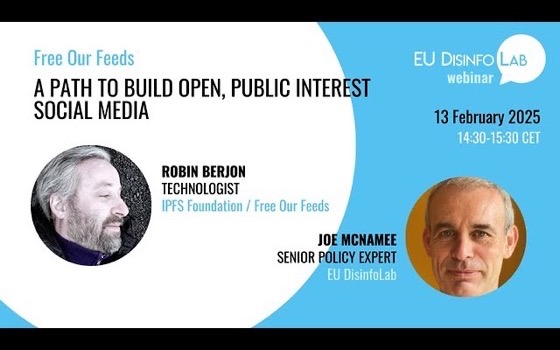
Free Our Feeds: a path to build open, public interest social media video
An EU DisinfoLab webinar on getting away from algorithms designed to generate polarised content: how open protocols open the door to public interest social media infrastructure and a healthier information environment. Moderated by Joe McNamee.
-

Europe - Community or Colony? Can we Build our Own Digital Infrastructure? video
A panel on sovereignty and infrastructure with Cristina Caffarra, Axel Voss, Marian Gläser, Jonas Andrulis, Andy Yen, and Ivan De Lastours.
-

Hearsay Culture Radio video
In this episode, Robin Berjon—technologist, deputy director of the IPFS Foundation, and former New York Times privacy and data governance lead—joins host Dave Levine (Associate Dean and Professor at Elon University School of Law, affiliate scholar at Stanford’s Center for Internet and Society) to dive into the challenges of digital infrastructure and how we can reclaim social media from billionaire capture.
-
The Public Interest Internet video
My talk at Web3 Summit 2024 at Funkhaus Berlin: what it would take to run the internet as public interest infrastructure rather than as a set of privately governed platforms.
-
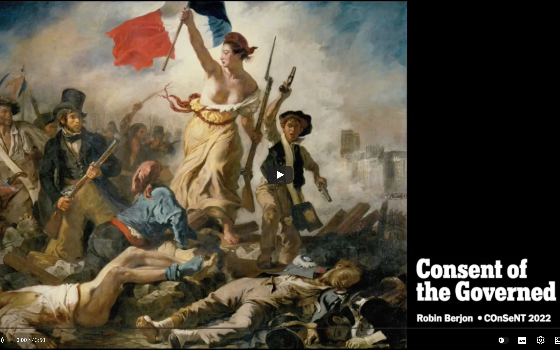
Consent of the Governed — keynote at the Consent Workshop 2022 video
An overview of the problems with consent in privacy.
Reports
-
A Real Digital Omnibus for European Competitiveness and Security report
This document is an expert contribution to ongoing discussions about the data aspects of the Digital Omnibus. My purpose is to provide the framework and background information necessary for trilogue interlocutors to identify which provisions can be retained, which can be improved, and which should be reconsidered, so that the final Omnibus achieves the impact that its proponents seek.
-

Funding The Web: From Cartel to Covenant report
Browsers are critical public infrastructure that no one pays for. The search/browser levy that funds them has become a de facto private government of the web; this report documents it, analyses its harms, and lays out a toolbox to place it under public-interest governance.
-

Airbus for AI: A Global Strategy for Public Value Creation report
A policy brief proposing a Public AI Company: a coordinated public-private partnership among middle powers, modelled on Airbus, to build frontier AI that serves shared economic and security interests.
-

Algorithmic Pluralism: Towards Competitive & Innovative Information Ecosystems report
Sherif Elsayed-Ali and Robin Berjon co-authored this Future of Technology Institute report on ‘algorithmic pluralism’, the idea according to which democracy requires pluralism in all editorial channels, including algorithms that determine what is relevant to people.
-
#EuroStack: European Strategic Sovereign Digital Infrastructures report
The pitch document that launched EuroStack: joining and building the logical and physical infrastructures — from chips to data to compute to connectivity — that secure Europe’s role in competitive digital value chains.